
The Top 5 Reasons Sustainability Is Becoming a Core Business Strategy
February 21, 2026
Why Conjoint Models Can Misrepresent Real Market Share
March 3, 2026Most firms think they lose high-cost purchases on price. Our research shows the decision is often made before price is even discussed.
When firms analyze why they win or lose high-cost consumer purchases, the default assumption is often the same: price decided it. Our research suggests that assumption is wrong.
Below is how the decision actually unfolds.
1. Preferences Form Before Sales Engagement
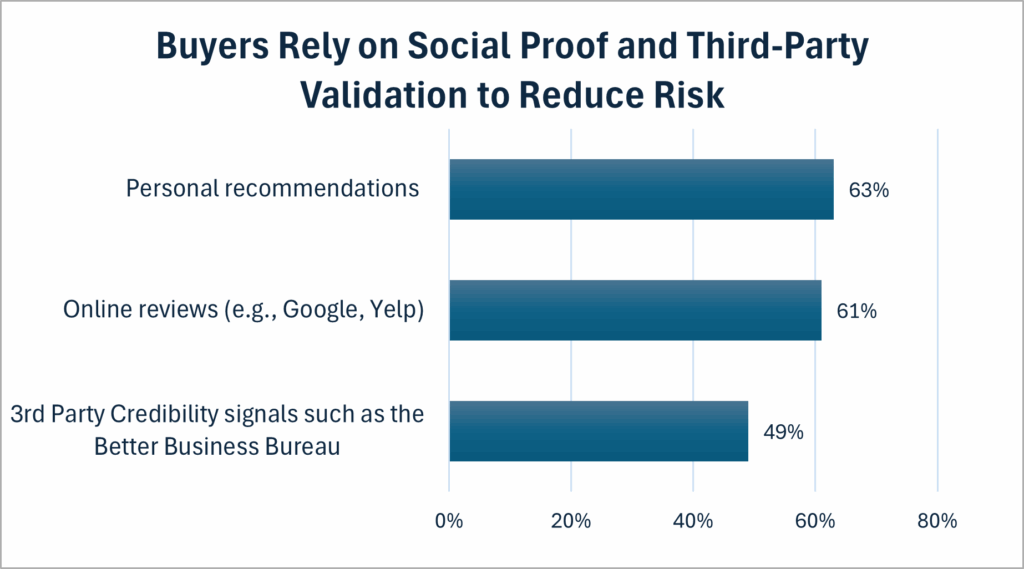
High-cost purchase decisions do not begin with a sales call. Buyers independently narrow their options well in advance, relying on social proof and third-party validation to reduce risk.
Key findings:
Homeowner comments:
“I already knew who I would and wouldn’t call before talking to anyone.”
“Reviews and referrals narrowed my options before I reached out.”
What this means: Providers are being eliminated before sales engagement begins. Brand, reputation, and third-party validation now function as pre-qualification filters, not marketing fluff.
2. Price Filters. Trust Decides.
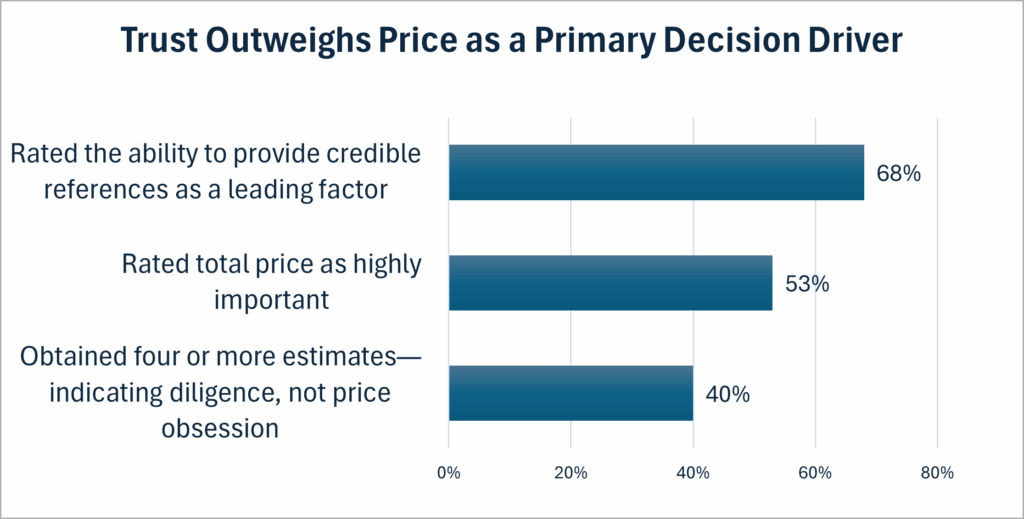
While price matters, it does not dominate decision-making in high-cost purchases. Instead, buyers prioritize confidence and risk reduction.
Key findings:
Homeowner comments:
“Price mattered, but I cared more about knowing they’d done this before and wouldn’t mess it up.”
“I wasn’t looking for the cheapest option—I wanted the one I felt confident wouldn’t cause problems later.”
What this means: Price operates as a filter, not a decision-maker. Trust, proof, and perceived reliability do more to determine the winner than marginal price differences.
3. Buyers Don’t Buy Prices — They Buy Monthly Reality
Buyers evaluate affordability through the lens of cash flow and flexibility, not absolute cost.
Key findings:
-
61% ranked financing availability as a top-tier factor
-
45% still prioritized financing even for smaller service or repair decisions
Homeowner comments:
“Once they showed me the monthly payment, it felt manageable—even though the total price was higher.”
“Financing made it possible to choose what I actually wanted instead of just what I could pay upfront.”
Implication for leaders: If your sales teams lead with total price instead of cash-flow framing, you are forcing buyers into unnecessary risk trade-offs — and losing premium options before price comparison even begins.
4. Incentives Reframe Value, Not Just Cost
When incentives are clearly explained, buyers are more willing to invest in higher-quality options.
Key findings:
-
35% prioritized long-term durability and lifespan
-
31% valued government incentives or tax credits
-
23% responded to manufacturer rebates
Homeowner comments:
“The tax credit made me comfortable going with the higher-efficiency option.”
“Once they explained the rebate and long-term savings, the higher price made sense.”
What this means: Purchasers reward providers who act as financial guides—helping them navigate incentives and long-term value—not those who simply discount.
5. In High-Risk Situations, Credibility and Speed Win
For service and repair decisions, urgency increases—but price still does not dominate.
Key findings:
-
42% prioritized warranties
-
40% prioritized rapid availability
-
25% looked for formal certifications as proof of competence
Homeowner comments:
“At that point I just wanted someone qualified who could show up quickly.”
“I wasn’t going to gamble on price when something expensive could go wrong.”
Key Takeaway: As perceived risk rises, price sensitivity declines. Credibility and responsiveness become decisive.
What This Means for Firms Competing on High-Cost Purchases
Across every stage of the journey, the pattern is consistent:
Price matters—but it is not the primary driver of choice.
Firms that consistently win high-cost purchases do not compete on price first — they do the following instead:
-
Make trust visible early
-
Provide proof proactively
-
Reduce execution and financial risk
-
Structure affordability, not just cost
-
Win on speed when timing matters
For organizations relying on price competition alone, the real issue is not pricing—it’s a misunderstanding of how decisions are actually made.
Why This Generalizes Beyond Home Improvement
These dynamics mirror how executives evaluate high-risk investments in enterprise software, industrial equipment, healthcare services, and professional services — where trust, proof, and downside risk dominate marginal price differences.
Although this study focused on homeowners making major home investments, the underlying decision dynamics extend well beyond this category.
-
Preferences form early, before formal sales engagement
-
Trust and risk reduction outweigh price differences
-
Financial structure matters more than sticker price
-
Proof and credibility determine shortlist inclusion
-
Price becomes relevant late, as a justification—not a driver
Organizations that believe they are competing on price are often competing too late.
At Visions Research, we help firms identify where decisions are actually won or lost — before pricing discussions even begin.
About the Research. Based on a quantitative study of 150 U.S. homeowners making high-cost home purchase decisions—in this instance for HVAC equipment and services..