
Why Concepts Test Well—Then Fail in the Real Market
April 22, 2026
Executive Summary
Concept tests often overstate demand because they ask for purchase intent before confirming personal relevance.
In this study, respondents were not only asked how attractive they found a new product idea and how likely they would be to buy it. They were also asked to describe the type of person who would find the product very appealing. Then they were asked how much that description fit themselves.
That second question made purchase intent much more meaningful. Respondents who could describe the likely buyer and see themselves in that description represented a more credible demand pool than respondents who simply found the concept attractive.
The key finding: purchase intent becomes a stronger predictor of market demand when respondents see themselves as the kind of person the product is for.
The Problem with “Would You Buy?”
Purchase intent is often treated as the central measure in concept testing. But purchase intent is not the beginning of the decision process. It is closer to the end.
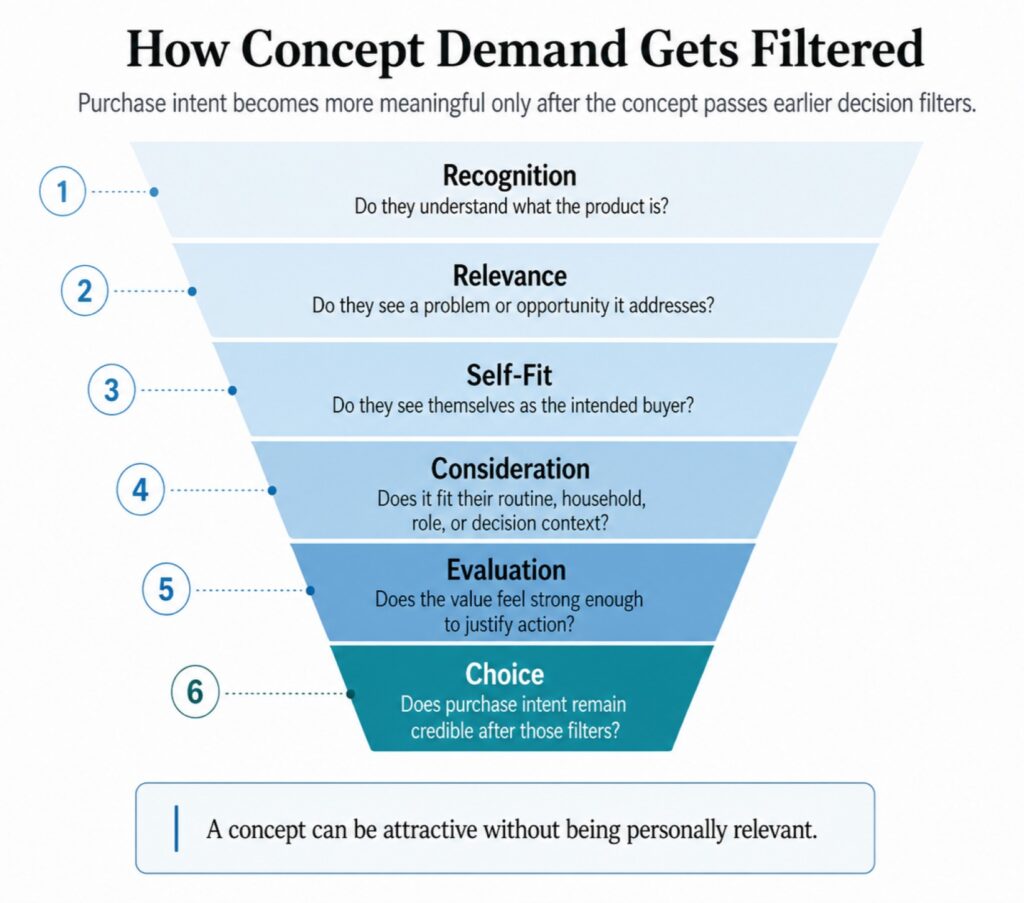
Before a respondent can give a meaningful answer to “Would you buy this?”, the concept has to pass several earlier filters:
- Do they understand what the product is?
- Do they see a problem it solves?
- Do they believe that problem applies to them?
- Do they see themselves as the kind of person who would use it?
- Does the benefit feel important enough to justify action?
Traditional concept tests often jump directly to the final question. That can make a concept look stronger than it really is.
A respondent may think, “That is a good idea,” while also thinking, “It is not really for me.” If the research only captures the first reaction, demand may be overstated.
A Better Question: Who Is This Really For?
In this study, respondents were asked a more revealing open-ended question:
“Please paint me a picture of the type of person who would find this product idea very appealing. Tell me about the person’s lifestyle, attitudes toward life, and the role that this product plays in their lives.”
After describing the likely buyer, respondents were asked how much that description fit themselves.
That sequence changes the interpretation of purchase intent. Instead of only asking, “Would you buy this?”, the research first asks:
- Who does this product appear to be for?
- What kind of life, routine, or problem does it seem to fit?
- Does the respondent see themselves inside or outside that buyer image?
This created a powerful second filter. It helped distinguish people who found the idea interesting from people who represented a more credible market.
Self-Fit Made Purchase Intent More Predictive
The results showed why this second question matters.
Self-fit sharply separated respondents who saw the concept as personally relevant from those who were evaluating it from a distance.
| Self-Fit Score (1 to 100) | Probably / Definitely Would Buy |
|---|---|
| Low self-fit Under 40 |
17% |
| Mid self-fit 40–69 |
62% |
| High self-fit 70+ |
86% |
That is the core evidence.
The “type of person” question was not just qualitative color. It became a purchase-likelihood filter.
Only 17% of low self-fit respondents said they would probably or definitely buy. Among high self-fit respondents, that increased to 86%.
That difference shows why direct purchase intent can be misleading. People may understand the concept, and even like it, but unless they see themselves as the likely buyer, their stated interest is less likely to translate into real demand.
Attractiveness Alone Was Not Enough
Attractiveness is still useful. But by itself, it can overstate demand.
Among respondents who rated the product 70 or higher on attractiveness (out of 100), 78% said they would probably or definitely buy it. On the surface, that looks like a strong result.
But when self-fit was added, the story became more precise.
| High-Attractiveness Respondents | Probably / Definitely Would Buy |
|---|---|
| High self-fit | 90% |
| Mid self-fit | 80% |
| Low self-fit | 47% |
This is where the methodology becomes especially useful.
Among people who found the product attractive, purchase interest was highest when the respondent also saw themselves as the likely buyer. But when attractiveness was paired with low self-fit, purchase intent dropped sharply.
That low self-fit group is important. These are the people who can inflate concept scores. They see the appeal, but they do not fully see themselves as the buyer.
If the research only measured attractiveness, these respondents might look like strong prospects. Once self-fit is considered, many look more like concept admirers than true buyers.
What the Buyer Descriptions Revealed
The open-ended buyer descriptions showed how respondents were making sense of the product.
Some described the likely buyer as someone busy, practical, and trying to simplify daily routines:
“A person who has a busy schedule would benefit from this product. If someone is very busy, they need to rely on a product that makes life easier for them.”
“This would be a good product for someone with a household of people who enjoy different types of coffee and would appreciate the convenience.”
“Someone who loves coffee but prefers it a certain way and they won’t drink it unless it’s exactly that way.”
These responses point to real use cases: busy mornings, multiple users, different preferences, routine consistency, and personalized convenience.
Other descriptions suggested more distance from the product:
“A person that is wealthy enough to buy things that aren’t really necessary.”
“A person who would buy this would want to be the person with the newest thing before anyone else.”
“People with money to waste would like this product.”
Those respondents may understand the product’s appeal, but they are describing a buyer who feels different from themselves.
That difference matters.
The buyer-image question reveals whether the product is being interpreted as personally useful, merely interesting, or even indulgent. The self-fit score then shows whether the respondent belongs in the demand pool they just described.
Reading Purchase Intent More Carefully
A concept can be attractive without being personally relevant.
That distinction is one reason traditional concept tests can overstate likely purchase behavior. A respondent may rate a concept highly because it sounds useful or innovative. But when asked who the product is really for, they may describe someone else.
The self-fit question helps identify whether the respondent is evaluating the product as a real personal option or simply as an interesting idea for someone else.
| Group | Pattern | Implication |
|---|---|---|
| True Prospects | High appeal + high self-fit + likely to buy | Most credible demand signal |
| Persuadable Prospects | High appeal + moderate self-fit | May respond to sharper positioning |
| Concept Admirers | High appeal + low self-fit | Risk of overstating demand |
| Non-Prospects | Low appeal + low self-fit | Limited near-term opportunity |
This approach does not reject purchase intent. It makes purchase intent more meaningful.
The strongest demand signal is not simply:
“I would probably buy this.”
It is:
“I find this attractive. I understand who it is for. That person sounds like me. And I would probably buy it.”
That is a more credible indicator of real market potential than simply counting everyone who says they would probably buy.
The Business Implication
For product teams, innovation teams, and marketers, the implication is significant.
A concept test should not simply identify whether people like an idea. It should identify which people have a believable reason to buy it.
That distinction affects product strategy, forecasting, targeting, messaging, and launch planning.
If many respondents like a concept but describe the buyer as someone else, the concept may need sharper positioning or a more focused target audience.
If respondents see themselves in the buyer image but hesitate on purchase, the barrier may be price, trust, complexity, or perceived value.
If respondents describe the buyer in a way the company did not expect, the research may reveal a better target market than the one originally assumed.
Each of those findings leads to a different business decision.
Final Insight
Concept tests overstate demand when they treat stated purchase intent as a direct measure of market behavior.
A better approach is to ask whether the concept passes the filters that buyers actually use.
The buyer-image question does something traditional concept tests often miss. It reveals who respondents think the product is really for. The self-fit question then shows whether the respondent belongs inside that buyer image.
In concept testing, the goal is not just to measure appeal. The goal is to identify demand that can survive real-world decision filters.
Frequently Asked Questions
Why do concept tests overstate demand?
Concept tests can overstate demand when they treat stated purchase intent as a direct measure of market behavior. Respondents may find a concept appealing but still not see themselves as the kind of person who would actually buy it.
Is purchase intent a good predictor of demand?
Purchase intent can be useful, but it becomes more predictive when it is interpreted alongside personal relevance, self-fit, and the respondent’s understanding of who the product is really for.
How can concept testing be improved?
Concept testing can be improved by asking respondents to describe the likely buyer, then measuring how closely that buyer description fits themselves. This helps separate true prospects from people who simply admire the concept.
Next Step:
Explore the Decision System Framework →
If your concept tests well but market adoption remains uncertain, we help clients identify where demand is created — and where it is lost.