
Why High Awareness Did Not Translate Into Usage
A widely adopted solution was seen as valuable—but was not used by most customers in practice.
Usage depended on how customers actually operated—not on awareness, installation, or perceived value.
We evaluated whether increasing adoption required product changes—or a deeper understanding of how decisions were made within the customer’s workflow.
The Challenge
A global provider had introduced a mobile application designed to improve monitoring and operational control.
The opportunity appeared clear:
- Awareness of the application was nearly universal
- Most customers had installed it at least once
- The value proposition was widely understood
Yet actual usage remained limited.
Traditional explanations focused on familiar factors:
- Lack of awareness
- Installation barriers
- Missing features
But these did not explain the pattern observed in the market.
The Decision
The organization needed to determine how to increase adoption and engagement.
Specifically, it needed to determine whether low usage reflected lack of need, adoption barriers, or how customers actually worked.
The options were straightforward:
- Invest in additional features
- Increase marketing and communication
- Redesign the product experience
But each of these assumes that usage is driven by product attributes.
The critical question was different:
Is low usage a product problem—or a reflection of how customers actually operate?
What We Found
Usage is not driven by awareness, installation, or perceived value—it is determined by how customers operate.
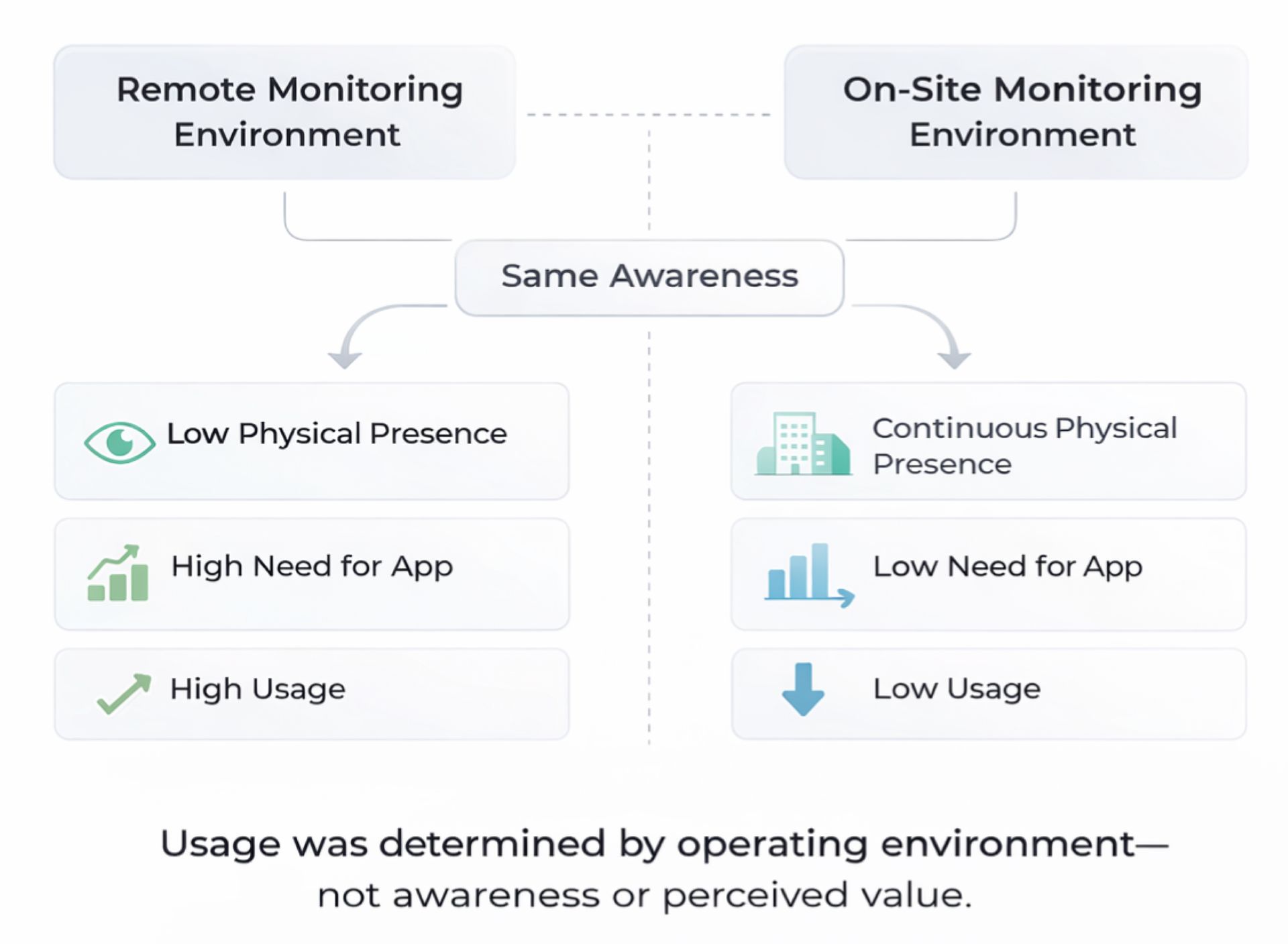
In practice:
- Customers who operated in environments requiring remote monitoring used the application frequently
- Customers who were physically present and continuously monitoring operations had little need for it
- Perceived value was high across both groups—but relevance differed
This created a clear pattern:
- High awareness did not lead to sustained usage
- High stated value did not translate into adoption
- Feature improvements alone would not change behavior
The application was used when it fit the operating environment—and ignored when it did not.
The Strategic Shift
The implication was not to improve the product.
It was to redefine the problem.
Rather than asking how to increase adoption, the focus shifted to identifying where adoption was structurally viable.
- Target customers whose operations require remote monitoring
- Position the application around specific use cases—not general benefits
- Align development with environments where the application fits naturally
This reframed the role of the product:
Not as a universally valuable tool—but as a solution for a specific type of operating environment.
Final Insight
Most product adoption challenges are framed as awareness or feature gaps.
In reality, they are often determined before evaluation begins.
By the time a customer evaluates a product, its relevance has already been defined by how they operate.
When this structure is not understood, adoption strategies focus on the wrong levers.
Usage is not driven by what customers say they value—it is determined by whether the product fits how decisions and actions actually occur.
This system is not theoretical
It is built from decades of research into how decisions actually unfold in real markets—where outcomes are determined long before evaluation begins.
Trying to Understand What Drives Product Adoption?
Visions Research helps companies determine whether adoption is shaped by awareness, features, usability, workflow fit, or how customers actually operate.