
Measuring the Real-World Purchase Process Is Essential
Research results can go astray when the path a buyer actually takes — the real-world purchase process — is not fully understood before the research approach is built.
Buyers do not jump straight to a choice. They follow a path. Before they compare options, they have already narrowed the field based on what they know, what they trust, what feels relevant, what seems risky, and what appears worth considering.
The Decision System is our framework for ensuring that the real-world process is understood and reflected in the research design. It shows how awareness, consideration, evaluation, choice, and market outcomes connect — so research results better reflect what is likely to happen in the market.
The Decision System: Visual Overview
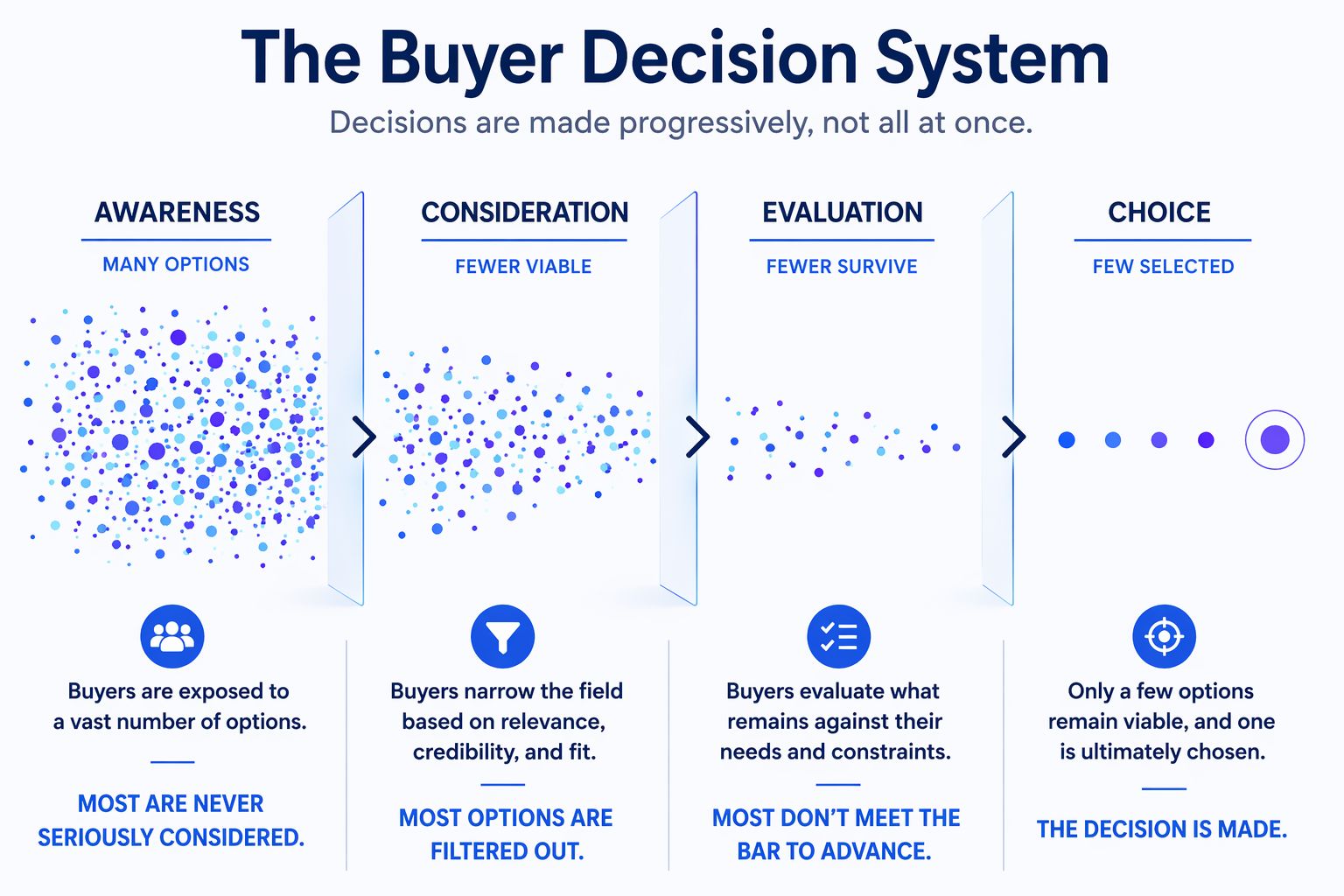
This framework guides how we design research to capture not just what buyers prefer, but what they recognize, trust, consider, compare, and ultimately choose.
Where Most Research Breaks Down
Many research approaches assume:
- All options are equally known
- All options are equally considered
- Buyers evaluate all features objectively
- Price is evaluated independently of perceived quality
In reality, these assumptions do not hold.
Most decisions are shaped before trade-offs begin. When early-stage filtering is not captured, research can overstate demand, misrepresent competition, and lead to incorrect strategic decisions.
What Drives Real-World Outcomes
Outcomes are not determined by stated preference alone.
They are determined by which options enter and survive the decision process:
- Many options are never considered
- Some are eliminated before evaluation begins
- Trade-offs occur only within a constrained set of viable choices
This is why technically sound models can still misrepresent real-world behavior.
Why This Changes Strategy
When decisions are understood as a system, strategy changes:
- Pricing: Must reflect perceived credibility and risk—not just elasticity
- Positioning: Must align with where the brand is seen as credible
- Market Entry: Must account for whether the offering will be considered at all
- Segmentation: Must reflect how different buyers filter options
Decisions are not independent—they are shaped by the same underlying system.
From System to Research Design
The Decision System is not only a way to describe buyer behavior. It shapes how research is designed.
Once the decision process is understood as a system, research can be built to examine how buyers become aware of options, what they consider credible, how they evaluate risk, which trade-offs matter, and what is likely to happen under real market conditions.
This is where the framework becomes practical: qualitative research, quantitative research, advanced analytics, and AI-enhanced synthesis each play a role in understanding how decisions form and how outcomes are determined.
Final Thought
Most research describes behavior.
Few approaches model how decisions are actually formed.
When the full system is captured—awareness, consideration, risk, and trade-offs—insight shifts from description to prediction.
This framework connects directly to how we evaluate pricing, positioning, and market opportunity in practice.
This system is not theoretical.
It is built from decades of research experience into how decisions actually unfold in real markets.