
We Study What Shapes the Decision Before the Choice Is Made
The Decision System explains how market outcomes are shaped as buyers move through the real-world purchase process — from awareness to consideration, evaluation, choice, and outcome.
That matters because research can produce misleading results when it asks what buyers prefer without knowing whether buyers understand what the option offers, take it seriously, trust the claim, perceive risk, and see enough value to act.
Visions Research turns that framework into research design.
Most research asks what buyers prefer. We help clients understand what shapes whether an option is known, considered, trusted, and ultimately selected.
How We Apply the System
To predict market outcomes accurately, research has to reflect the decision system buyers actually move through before they choose.
That means understanding whether an option is recognized, understood, taken seriously, trusted, considered, and compared before asking what buyers prefer.
We apply this approach to product development, pricing, portfolio design, positioning, market entry, customer segmentation, and message strategy.
Using qualitative research, quantitative research, advanced analytics, and AI-enhanced support, we model those dynamics clearly enough to guide business decisions.
How We Model the System
Our approach does not treat awareness, consideration, evaluation, and choice as separate steps. We model how they interact in real decision environments.
- How awareness constrains what is even possible
- How consideration filters reshape competitive dynamics
- How evaluation reflects risk, trade-offs, credibility, and real-world constraints
- How multiple stakeholders influence the final outcome
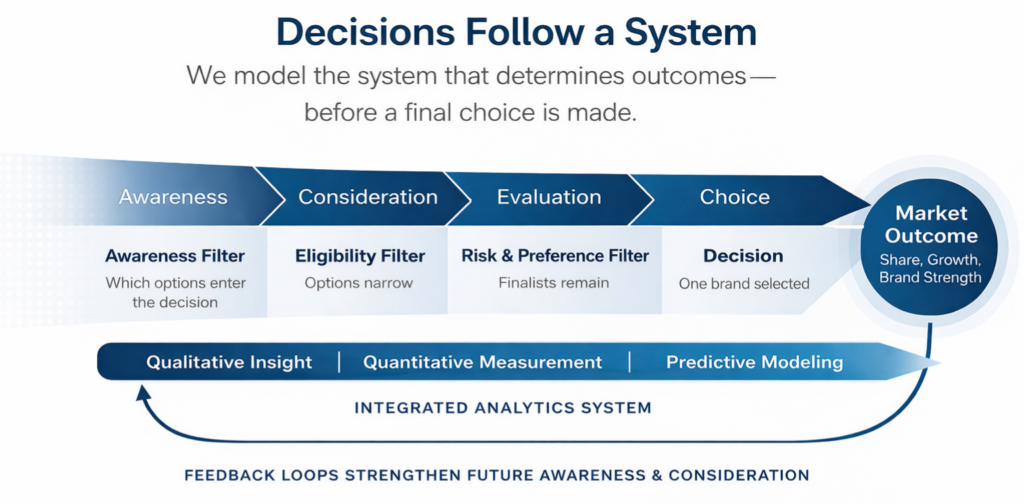
These stages interact to determine outcomes—long before a final choice is made.
Where Most Research Breaks Down
Most research designs assumes a market that does not exist.
Those assumptions shape the results clients rely on.
When these assumptions fail, the conclusions fail with them.
Most research assumes:
- Equal awareness across options
- Full consideration of all alternatives
- Feature-driven decision-making
- Independence of price from perceived quality
- Single decision-maker assumption vs. multi-stakeholder decision processes
When these assumptions fail:
- Demand is overstated
- Share is misrepresented
- Pricing decisions are wrong
Where This Matters Most
We are often engaged when decisions carry financial or strategic risk:
- New product viability
- Pricing strategy under uncertainty
- Competitive response
- Portfolio prioritization
- Market entry and positioning
- Customer segmentation and targeting
Three Ways We Apply the Decision System
1. Decision Formation
Qualitative research reveals how buyers frame the problem, perceive risk, and decide what enters consideration.
- Defines how the problem is framed
- Determines what criteria are used
- Shapes how risk is perceived
- Filters what enters consideration
Defines what is considered—and what never enters the decision.
2. Market Structure
Quantitative research measures how buyers evaluate alternatives, prioritize trade-offs, and segment into different decision patterns.
- Defines the structure of the market
- Determines which trade-offs drive decisions
- Establishes price–value relationships
- Shapes choice within the consideration set
Determines which options advance—and which are eliminated before choice occurs.
3. Modeling Market Outcomes
The final stage of the decision system — where outcomes become measurable and predictive.
Advanced analytics simulates how decisions translate into share, pricing response, portfolio performance, and market outcomes.
- Estimates likely share, pricing response, and portfolio performance
- Reflects what buyers realistically consider
- Captures how competitors enter, exit, and respond
- Tests strategic scenarios under real market conditions
Reveals what is likely to happen — not just what respondents say they will do.
Beyond the research design itself, AI-enhanced support can help clients continue working with the findings after the study is complete.
AI-Enhanced Research Support
Research often becomes most valuable when clients begin applying the findings to real decisions.
Our AI-enhanced research support helps client teams explore the data collected and analyzed for a study — including survey results, qualitative interviews, open-ended responses, cross-tabs, segmentation, and prior analysis.
Clients can ask follow-up questions, compare responses, find relevant quotes, and examine what-if scenarios while staying connected to the study data.
See how we use AI to help clients understand research more deeply →
Our Role
We are not a fieldwork provider.
We are brought in when the decision must be right.