
Customers appeared highly price-sensitive—but the real opportunity was hidden in how choices were actually made.
The Decision
A global provider of industrial equipment services needed to define the optimal structure and pricing of its maintenance offerings.
The objective was clear:
Increase market share in a competitive environment where multiple providers offered overlapping service contracts.
But the path forward was not.
The Challenge
Traditional research would have led to a familiar conclusion:
- Price is the most important factor
- Customers prefer more features
- Brand influences selection
But this framing misses how decisions actually occur.
In reality:
- Buyers evaluate complete service packages, not individual attributes
- Price sensitivity changes depending on the range of options considered
- Different customers use fundamentally different decision logic
A single “best” offering does not exist in a market like this.
Our Approach
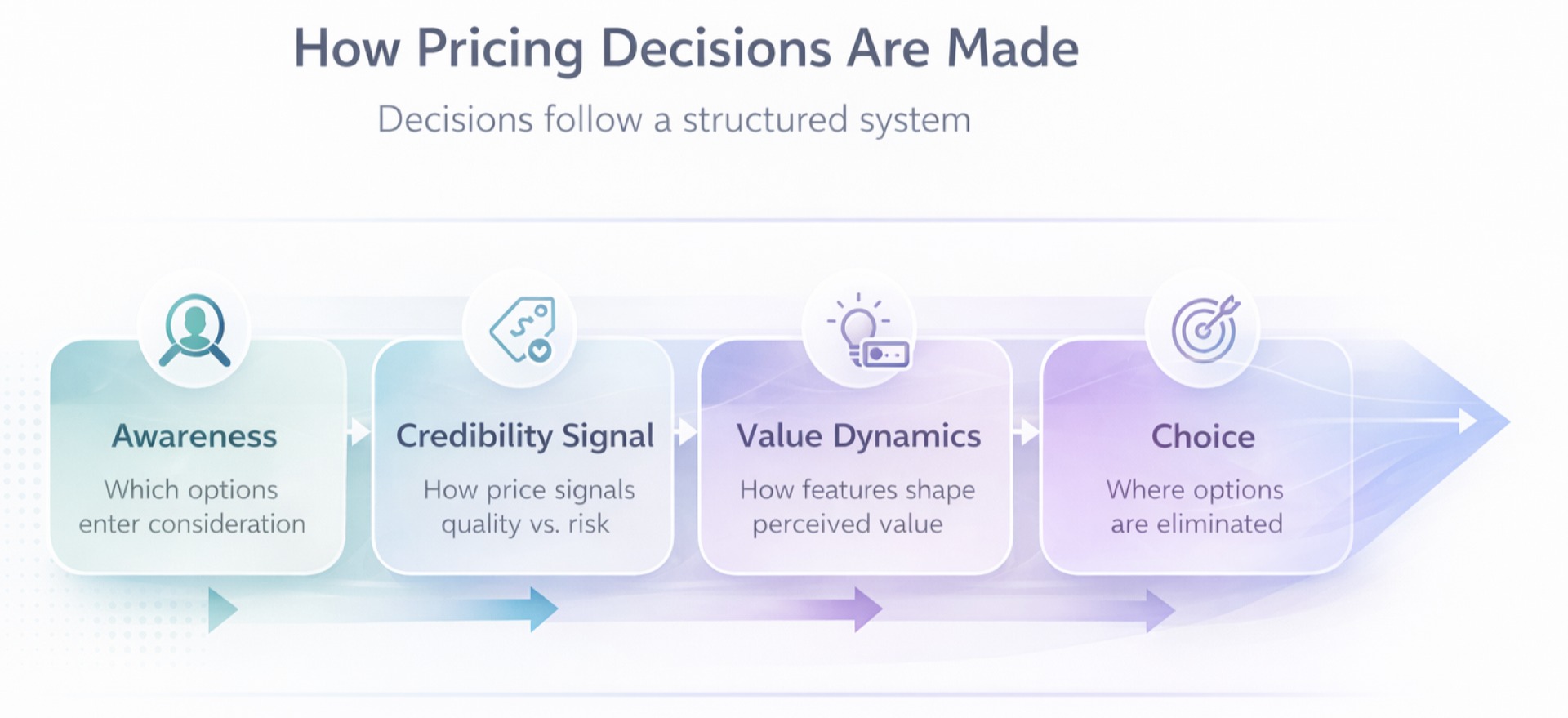
We modeled how buyers evaluate complete service offerings within a realistic decision environment.
Rather than asking what matters, we modeled how choices are made:
- Which combinations actually drive selection and switching
- How sensitivity changes under different competitive conditions
Respondents evaluated realistic service offerings—each defined by a combination of:
- Pricing levels
- Feature configurations
- Service structure
- Provider type
Each decision required trade-offs—mirroring how purchases are actually made.
What We Found
Pricing outcomes are not determined by price alone—they are shaped by the structure of the decision itself.
1. Price Dominates—But Only Under Certain Conditions
Price is a primary driver of choice—but its influence is conditional.
- Extremely low prices reduce attractiveness (“too cheap” signal)
- High prices sharply reduce selection
- Price sensitivity increases as the range of prices widens
When price differences narrow:
Features—not price—become the primary driver of choice
2. “Feature-Driven” Buyers Follow a Different Decision System
A meaningful segment of the market was not primarily price-driven.
These buyers are feature-driven.
This does not mean they “prefer features.” It means:
When forced to choose, they consistently select based on feature configuration—over both price and provider.
For this group:
- Features determine the outcome
- Price matters within a reasonable range
- Brand has limited influence
This is a fundamentally different decision system—not a preference shift
3. Three Distinct Decision Systems Operate in Parallel
The market is not uniform. It is structured around three decision systems:
Price-Driven
- Highly responsive to price changes
- Switch providers readily
- Sensitivity increases with wider price ranges
Feature-Driven
- Selection driven by feature configuration
- Will pay more for the right offering
- Less sensitive to price within realistic bounds
Brand-Loyal
- Preference anchored to provider
- Less responsive to both price and features
These are not segments of preference—they are different ways decisions are made.
4. Feature Design Can Override Price and Brand
One of the most important findings:
The right feature configuration can overcome both a price disadvantage and weaker brand positioning.
This shifts the strategic focus:
- From lowering price
- To engineering the right offering
The Most Important Outcome
The most valuable output was not identifying a single optimal service package.
It was the development of a market simulator.
This allowed the client to:
- Model multiple competitor offerings simultaneously
- Reflect how buyers choose in real competitive environments
- Test how price and feature changes impact market share
The objective shifted from finding the best offering to designing the portfolio that wins in the market.
The Strategic Shift
Instead of launching a single “best” offering, the client developed a 3–4 tier portfolio designed to:
- Capture distinct decision systems
- Compete directly against specific competitor offerings
- Avoid internal cannibalization
- Maximize total share across the market
Winning is not about optimizing a single offering—it is about designing the set of offerings that wins across the market.
Final Insight
Most research describes what customers say they value.
This study showed something more important:
Different buyers follow fundamentally different decision systems—and those systems determine outcomes.
When these systems are modeled correctly:
Strategy shifts from optimizing offerings to designing competitive advantage.
Most firms try to improve a single offering.
We help design the portfolio that actually wins.
Method Note
This study used a choice-based conjoint model to simulate how buyers evaluate service offerings across price, features, and provider—within real competitive contexts.
This is not a pricing problem—it is a decision system problem.
Planning a Pricing, Portfolio, or Product Strategy Study?
Visions Research helps companies turn buyer feedback into clearer decisions about pricing, portfolio design, and go-to-market strategy.