
When the Market Won’t Let You Reposition
A global technology provider was evaluating whether it could reposition its brand.
The opportunity appeared clear.
The company had expanded its capabilities well beyond its historical core. Leadership believed it could move into higher-value positions—platform, cloud, and broader business solutions.
But the question was not internal capability.
It was whether the market would accept that shift.
The Challenge
Traditional positioning work would suggest a familiar path:
- Expand into higher-value categories
- Align messaging to reflect new capabilities
- Shift perception through communication
But this assumes positioning is a choice.
In reality, it is not.
In reality:
- Buyers do not evaluate all positions equally
- Credibility is established before evaluation begins
- Some categories are never seriously considered
A brand cannot position itself where the market does not already see credibility.
The issue was not positioning—it was credibility within the market’s decision system.
What We Evaluated
We assessed how the brand was perceived across multiple positioning categories.
The objective was not to test positioning options.
It was to determine which positions were structurally viable.
Not conceptually—structurally defined by the market.
The study did not evaluate positioning options. It identified which options the market would consider—and which it would not.
What We Found
The results revealed a consistent structure—
not across categories, but across levels of credibility.
First: What the brand owns
The company occupied a dominant position in one category.
- It was consistently recognized
- It was frequently selected
- It defined how buyers understood the brand
In that space, the brand was not simply present.
It was the reference point.
Second: Where the brand can extend
Several adjacent categories showed partial credibility.
- Buyers could see the connection
- The brand felt plausible in those roles
- But it was not the primary association
These were reachable.
But not owned.
Third: Where the brand is excluded
Beyond that, credibility dropped sharply.
- The brand was not rejected
- It was not evaluated
- It was not part of the decision set
Other companies had already defined those categories.
The brand was not included.
This created a clear structure:
- A position you own
- Positions you can extend into
- Positions you are excluded from
Positioning is not a set of options. It is a structured set of constraints.
- Software
- IT Services
- Cloud Services
- Business Outcomes
- Business Solutions
- A platform provider
- Infrastructure provider
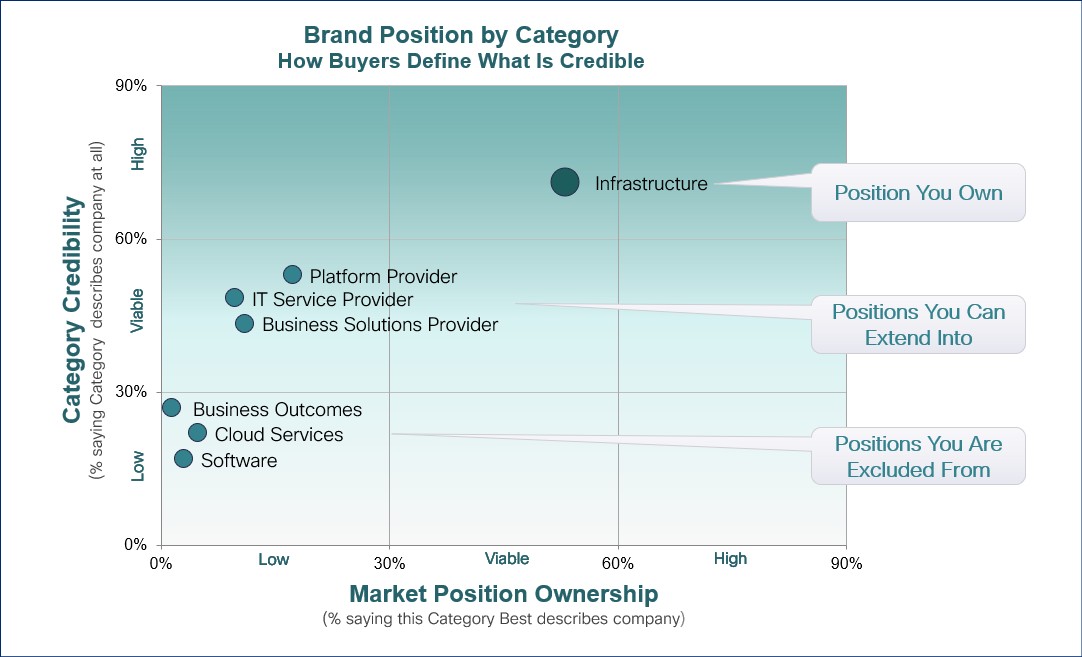
The chart makes this structure visible.
Not as categories.
As a progression.
At the top right, the brand occupies a dominant position.
Below that, adjacent positions become viable.
Further down, positions fall outside the decision set entirely.
This is not a spectrum.
It is a boundary system.
The Outcome
The study did not expand the set of options.
It reduced it.
Several positioning strategies were no longer viable—not because they lacked strategic appeal, but because the market did not see the brand as credible in those roles.
The company was no longer choosing between multiple strategic options.
It was choosing between positions the market would realistically accept.
The most valuable outcome was not identifying where to go—but where not to go.
The Strategic Shift
This required a different way of thinking.
Positioning was no longer treated as a choice.
It was treated as a progression.
- Strengthen the core position
- Extend into adjacent spaces
- Earn the right to compete further out
Not assume that right exists today.
Positioning is not a single decision. It is a sequence the market allows you to follow.
Final Insight
Most positioning is treated as a communication exercise.
In reality, it reflects how buyers organize the category.
- What is considered
- What feels credible
- What is possible
And what is not.
By the time repositioning begins, the outcome is largely set by how the market already sees you.
This is not a positioning problem—it is a decision system problem.
Evaluating a Market Entry, Investment, or Positioning Decision?
Visions Research helps companies determine whether a new position is credible, whether buyers will consider it, and whether it can realistically translate into market share, pricing power, and business impact.