
Preventing a Misguided Manufacturing Investment
Across six countries, manufacturing location was perceived as a strong advantage—but did not influence buying decisions.
Low visibility of country of origin and inconsistent brand selection limited its impact.
We assessed whether this perceived benefit would translate into share gain or pricing power—and whether the investment should proceed.
Background
A global industrial manufacturer was evaluating whether to open a manufacturing plant in a country known for high-quality production to enhance perceived product quality.
The study spanned six countries, capturing buyer perceptions of manufacturing quality, competitive structure, and decision dynamics.
The hypothesis was straightforward:
Manufacturing in this country would strengthen perceived quality and support both share growth and a price premium.
Objective
Determine whether opening a new plant would:
- Expand consideration among target buyers
- Strengthen perceived quality and reduce risk
- Support a measurable price premium
- Translate into realistic, capturable market share
Our Approach
We analyzed each stage of the decision process:
Awareness → Consideration → Evaluation → Choice → Market Outcome
This included:
- Measuring awareness of manufacturing origin
- Identifying how brands enter and exit consideration
- Quantifying gaps between perception and actual knowledge
- Analyzing brand usage patterns within firms
- Profiling market structure across 22 competing brands
Critical Findings
1. Manufacturing in the Preferred Country Was Viewed Very Positively
Manufacturing in the preferred country was associated with:
- Higher perceived quality
- Greater reliability
- Lower perceived risk
- Willingness to pay a premium
…known for its precision and high-quality engineering
…Their craftsmanship is world-renowned, and we trust in its quality and quality control.
However:
Manufacturing in the preferred country was viewed very positively. But few buyers had enough knowledge of the category to know where the products they used were actually manufactured—and awareness of where competing brands were made was even lower.
- In nearly 40% of cases, buyers were incorrect about the manufacturing origin of the products they used
As a result, manufacturing location rarely entered the decision process in a consistent or meaningful way.
2. Consideration Was Fragmented in a Commodity Environment.
- Firms used 4+ brands on average
- No primary supplier emerged
- Leading brand share: ~33%
- Most brands ranged between 5%–25% share
Brand choice varied from purchase to purchase, rather than following a consistent preference.
The market functioned as a commodity environment with no dominant leader or stable preference structure.
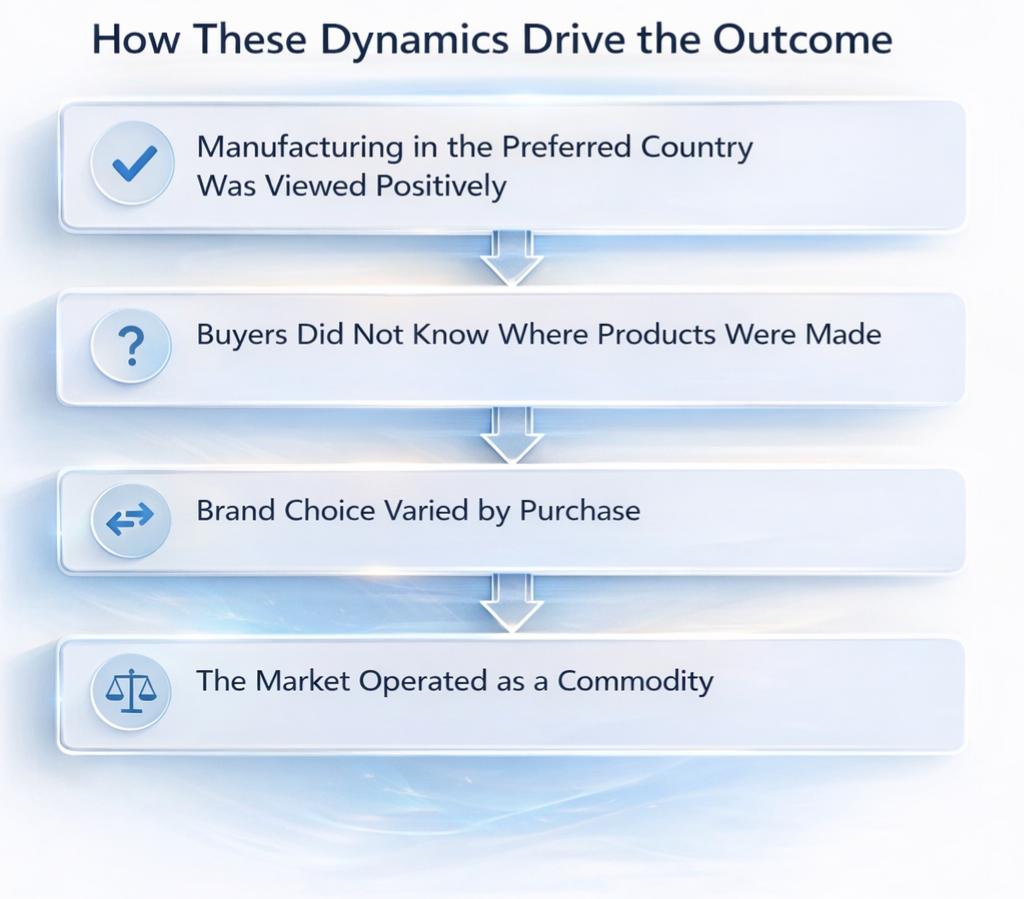
The issue was not whether the country of origin was valued—but whether it meaningfully influenced choice.
Low awareness and commoditized buying behavior prevented it from influencing decisions.
Implication
A traditional study would have concluded:
Manufacturing location was highly valued—supporting investment in a new facility.
This would have been incorrect.
The study showed that the attribute, while positive, would not materially influence share or pricing.
The investment would not deliver the expected return and should not proceed based on this rationale.
This was driven by:
- Buyers could not reliably identify which products had the attribute
- Brand choice was inconsistent across purchases
- Market structure did not support sustained differentiation
What This Means Strategically
The opportunity was not simply to change manufacturing location.
It was to address the market conditions required for that attribute to influence choice:
- Increase visibility of manufacturing origin
- Build clear association between brand and production attributes
- Reduce fragmentation in brand usage
- Establish more consistent entry into consideration sets
Bottom Line
A valued attribute does not drive market outcomes unless it is visible, understood, and consistently applied within the decision process.
Most research would have validated the attribute.
We identified why it would not translate into market impact.
This is not simply a manufacturing location problem—it is a decision system problem.
Evaluating a Market Entry, Investment, or Positioning Decision?
Visions Research helps companies determine whether perceived advantages can realistically translate into market share, pricing power, and business impact.