
What the Research Clarified
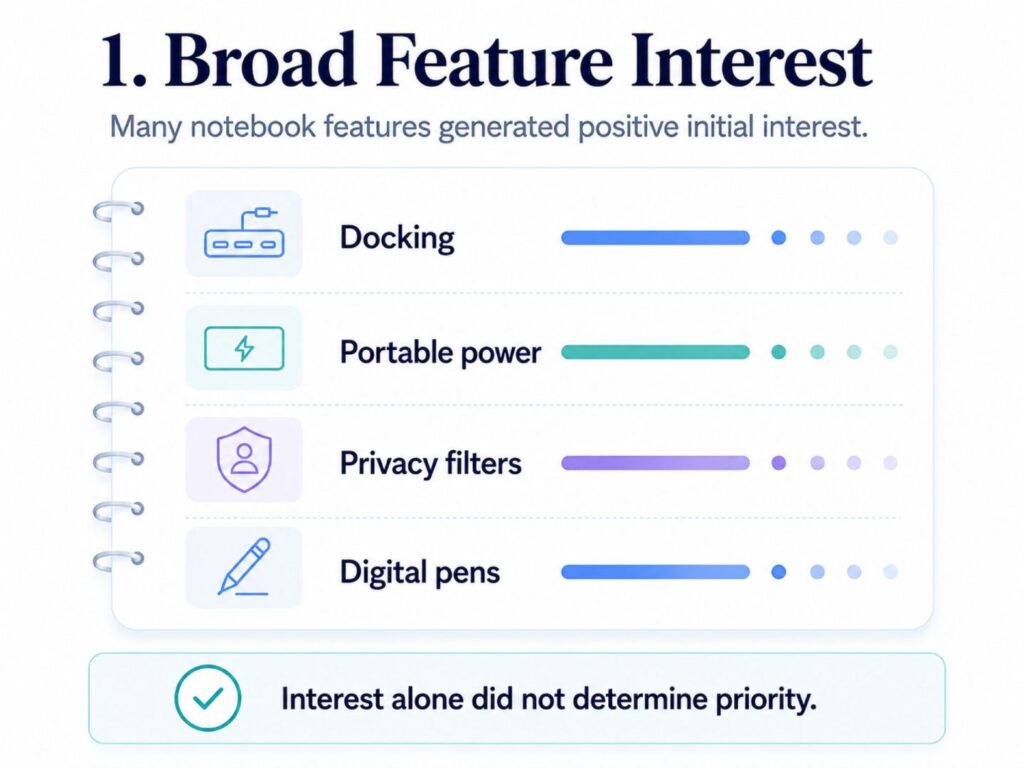
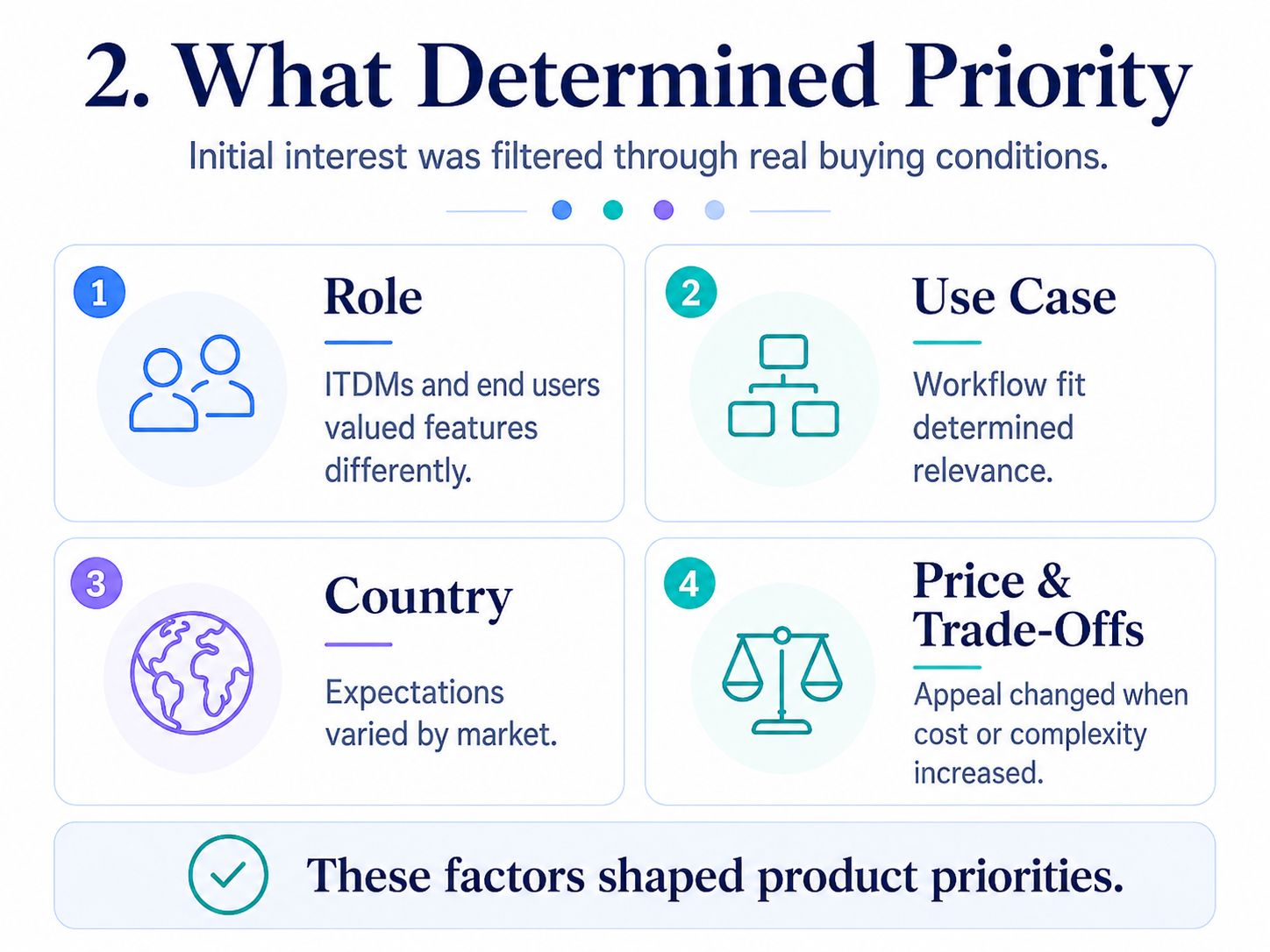
Feature interest alone was not enough to determine product priority. Each opportunity had to be interpreted through workflow, role, price sensitivity, adoption barriers, and country differences.
1. Established workflow features required configuration decisions
Docking was already embedded in business workflows. The question was not whether buyers used docks, but which docking solution best fit different needs, work settings, and value propositions.
Hard docks were associated with security, ports, and docking method. Wireless docks were associated with ease of use, cable management, design, and size.
Strategic question: Which docking solution fits which buyer need, workflow, and value proposition?
2. High-interest features still depended on practical trade-offs
Portable power packs generated strong interest, but appeal depended on the balance between battery life and weight. The strongest opportunity was not necessarily the highest-capacity option. It was the configuration that delivered meaningful battery extension without undermining portability.
Strategic question: Which benefit is strong enough to justify the added weight, cost, or complexity?
3. Privacy features were relevant, but not equally for all users
Integrated privacy filters had strong appeal, especially among IT decision makers and certain higher-risk user groups. The more useful insight was not simply that privacy mattered, but that privacy value depended on role, work setting, and risk context.
Strategic question: Should the feature be standard, optional, bundled, or targeted to specific segments?
4. Role-based adoption mattered as much as overall interest
Digital pens showed strong interest, but adoption varied sharply by role. Senior users were more likely to use them, while individual contributors were less likely to see the benefit.
The growth opportunity was not simply to promote the feature more broadly. It was to show lower-level users where the feature fit their work.
Strategic question: Which users already understand the value, and which users need education before adoption can grow?
5. Country differences changed pricing and positioning strategy
The same feature did not carry the same value in every market. Germany often showed narrower acceptable price ranges, while China appeared more open to higher prices or newer configurations.
A feature’s value is filtered through local expectations, installed behavior, price tolerance, category maturity, and buyer familiarity.
Strategic question: Where can one global product strategy work, and where does positioning or pricing need to vary?
The Strategic Value
The study gave the client a decision framework for product planning.
Rather than treating feature interest as a simple ranking exercise, the research identified where each feature sat in the buyer’s decision system:
| Strategic Question | What the Research Helped Determine |
|---|---|
| Is the feature broadly relevant or role-specific? | Which users and buyer groups would value it most |
| Is it already embedded in workflow? | Whether adoption required education or simply better configuration |
| Does interest survive trade-offs? | How price, weight, size, usability, or compatibility affected appeal |
| Does the opportunity differ by country? | Where positioning and pricing assumptions needed to vary |
| Is the feature a requirement, a differentiator, or a nice-to-have? | How it should be prioritized in product planning |
The result was a clearer understanding of which features could support broad commercial notebook strategy, which should be targeted to specific use cases, and where pricing or education would be critical to adoption.
Why This Matters
Product development teams often face pressure to add features because customers express interest in them.
But in B2B markets, interest is only the beginning. A feature must pass through a series of decision filters before it affects real purchasing behavior.
Buyers ask:
- Does this solve a real business problem?
- Which employees will use it?
- Does IT see value?
- Does the end user see value?
- Does it justify the price?
- Does it create support, compatibility, or deployment issues?
- Is it required for some users but unnecessary for others?
- Does the answer differ by country or company size?
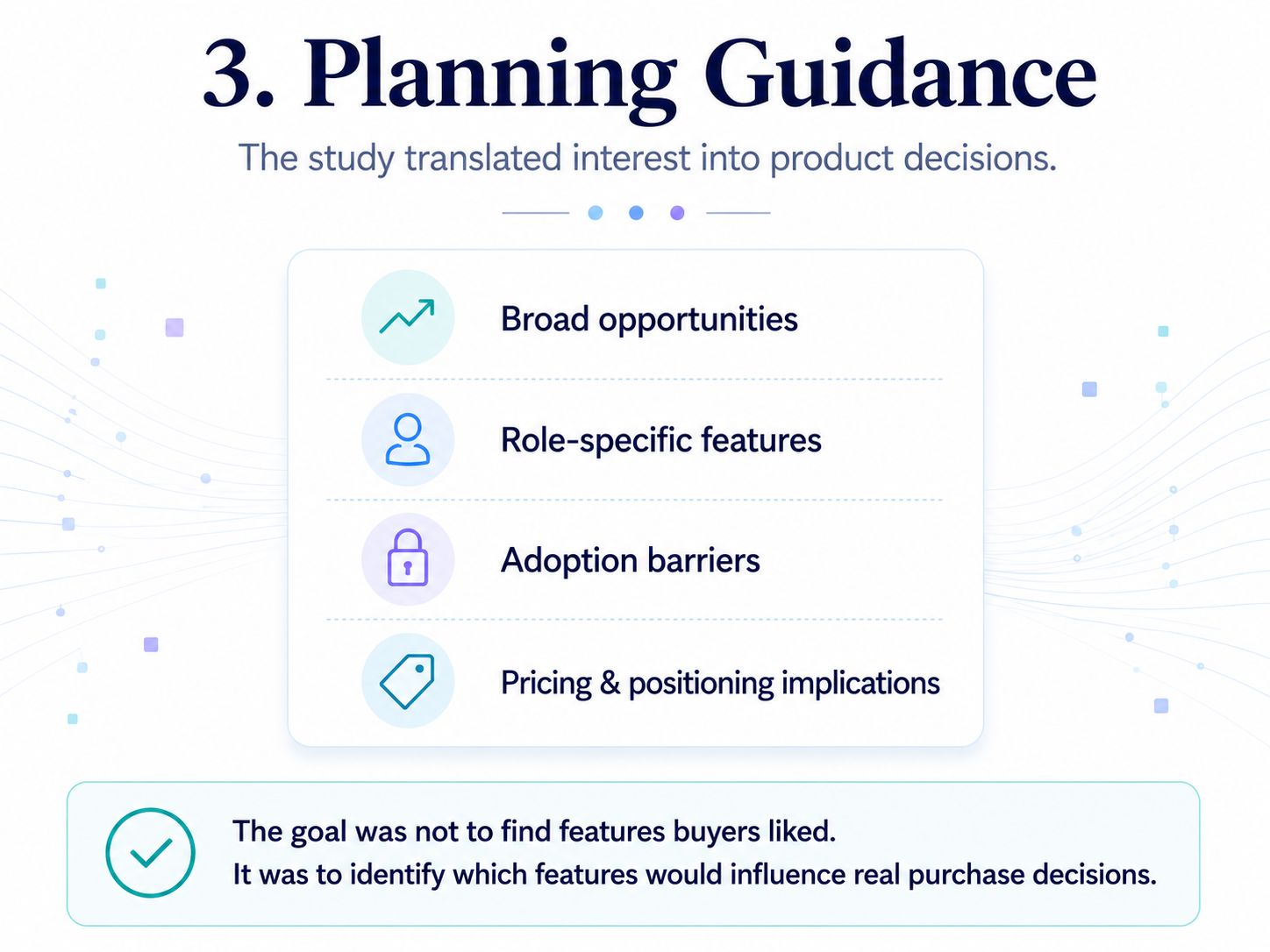
The value of research is not simply measuring whether buyers like a feature. It is determining whether the feature fits how the market actually makes decisions.
Planning a Product, Pricing, or Feature Prioritization Study?
Visions Research helps companies turn buyer feedback into clearer decisions about product design, pricing, and go-to-market strategy.