
Strategic AI: Helping Clients Understand Research More Deeply
Artificial intelligence can help clients explore, synthesize, and interpret research findings in new ways.
In strategic market research, the value is not simply in summarizing one source of data. The value comes from connecting multiple dimensions of the study — quantitative survey results, qualitative interviews, open-ended responses, cross-tabs, and advanced analysis such as segmentation — so client teams can ask better follow-up questions and explore what the findings mean.
In high-stakes business decisions, the real challenge is helping teams see where the nuance lies, how different respondent groups think, and how the research should inform the decisions that follow.
That is where AI-enhanced research support can add value: by helping clients interact with the study data more deeply during and after the final presentation.
At a Glance
- AI-enhanced research support helps clients interact with study data during and after the final presentation.
- Its strength lies in using the actual data collected and analyzed for the study — not generic outside assumptions.
- It helps teams identify patterns, compare responses, examine what-if scenarios, and find relevant quotes and comments.
- Our use of AI supports research judgment — it does not replace it.
Most Research Still Ends Too Soon
Many research projects end with a final report or presentation.
Those deliverables are necessary. They summarize what was learned, document the findings, and provide recommendations. But the business questions often continue after the formal presentation is over.
Product teams may want to revisit how buyers reacted to a concept. Sales teams may want language that explains likely objections. Marketing teams may want to understand which messages resonated and why. Senior leaders may want to test assumptions as market conditions or strategic priorities change.
In other words, the research may be complete, but the decision process is still active.
The opportunity is to make the research easier to revisit, question, and apply — without losing the judgment required to interpret it correctly.
From Static Reports to Guided Research Exploration
A final report or presentation is still essential. It provides structure, synthesis, recommendations, and a clear point of view.
AI-enhanced research support can turn the final report from a static deliverable into a platform for guided, data-based decision support.
In many strategic studies, the most useful questions emerge when teams begin applying the findings to pricing, messaging, product design, sales strategy, market positioning, or customer targeting.
AI-enhanced research support can help extend that conversation. In some engagements, this may involve a live working session where Visions Research uses an AI-assisted research model to explore client questions in real time using the data collected and analyzed for the study.
AI supports the exploration. The researcher provides the judgment, interpretation, and business context needed to connect the findings to the client’s objectives and decisions.
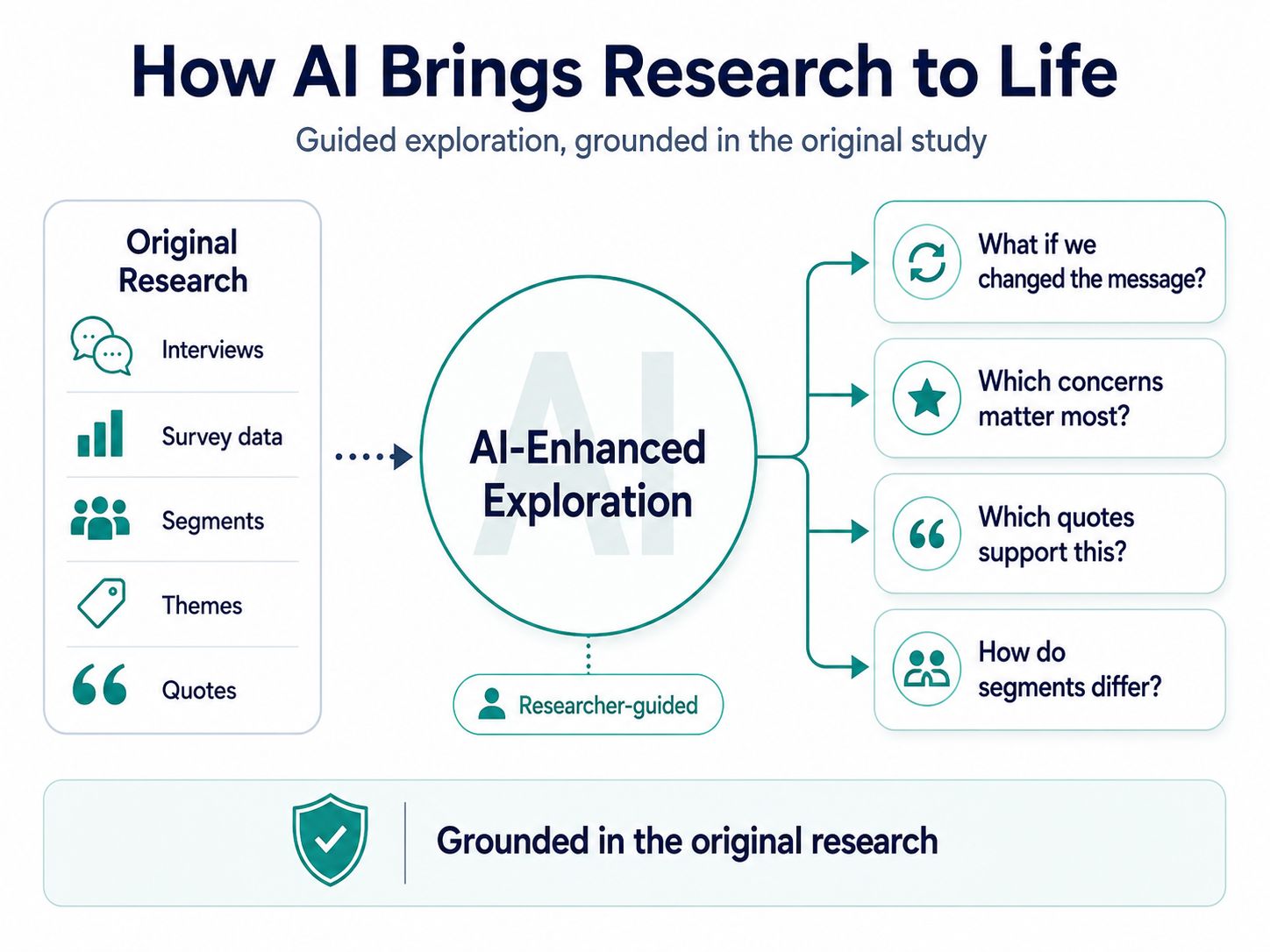
AI-enhanced research support helps teams explore questions, find relevant quotes, compare segments, and test scenarios while staying connected to the underlying data.
AI Can Bring Research to Life During the Final Presentation
AI-enhanced research support does not have to wait until after a report is delivered.
In the final presentation itself, AI can help make findings more vivid and easier to explore. A client may ask to see quotes behind a conclusion, compare how different respondent types reacted, or examine whether a concern was widespread or limited to a few respondents.
When used carefully, AI can help the discussion move beyond static slides. It can support a more interactive conversation about what the research means and how it should be applied.
The key is that the AI-assisted exploration uses the study data and is guided by researchers who understand the business decision, the research design, and the limits of the data.
Watch a short video of how AI-enhanced research support can help bring findings to life, find relevant quotes, and explore what-if scenarios.
AI Research Support Demonstration
Demonstration of how guided AI-enhanced research support can help explore study findings, compare respondent perspectives, and surface relevant quotes.
Example: A Guided AI-Enhanced Research Session
Consider a new product concept study that combines quantitative survey data, qualitative interviews, and advanced analysis such as segmentation.
The final report may summarize concept appeal, identify major objections, compare buyer segments, show which messages resonated, and recommend how the offer should be refined.
After the presentation, the client may have additional questions:
- Which respondents were most enthusiastic, and what language did they use?
- What concerns came up around implementation, credibility, or risk?
- How did reactions differ by buyer role, company type, or decision context?
- If we emphasized reliability instead of cost savings, how might buyers respond?
- Which quotes best support the recommendation?
In a guided AI-enhanced research session, Visions Research can help explore those questions live — finding relevant quotes, comparing segments, examining themes, and connecting the answers back to the survey data, interviews, and analysis.
AI assists the exploration. The researcher provides the judgment, context, and interpretation needed to turn the data into business guidance.
AI Can Help Teams Ask Better Follow-Up Questions
Our AI-enhanced research support adds value by helping teams explore the questions that emerge as findings are reviewed, discussed, and applied.
Research teams and business leaders often know the first question they want answered. But deeper value often comes from the second, third, and fourth questions:
- Why did one respondent group react differently than another?
- Which concerns were isolated comments, and which were recurring themes?
- Is the barrier price, risk, credibility, awareness, or perceived fit?
- Would a different message change how the concept is evaluated?
- Which respondent segment is most likely to reconsider?
AI-enhanced support can help teams move through that type of questioning more systematically — connecting qualitative data, quantitative findings, segments, themes, and prior analysis in ways that are difficult to do from a static report alone.
Our AI Support Is Based on the Study Data
Our AI-enhanced research support is based only on the data collected and analyzed for the study — including interview transcripts, survey responses, open-ended comments, segmentation results, cross-tabs, choice-model findings, themes, and prior analysis — rather than generic outside information.
That distinction matters. Generic AI can produce answers that sound plausible, but are not specific to the market, buyer audience, product category, or business decision being studied.
In market research, the most valuable insights are often found in the details: the hesitation behind a response, the language buyers use, the concerns only some respondents raise, and the practical constraints that shape real decisions. Those are often the details generic AI tends to smooth over.
AI is most useful in research when it helps clients explore the data actually collected — without replacing what buyers said and did with generic outside assumptions.
AI should not replace the voice of the market. It should make the data easier to explore, question, and apply.
Why Human Judgment Still Matters
AI can organize information, identify patterns, and accelerate exploration. But insight still requires experienced researchers.
This is especially important in B2B research, where audiences are often specialized, difficult to recruit, and shaped by industry context, organizational roles, and decision constraints that are not obvious from the data alone.
In market research, the most important questions are rarely mechanical. They require judgment:
- Is this pattern meaningful or just noise?
- Are respondents describing what they would actually do, or what sounds reasonable in a research setting?
- Does the finding change the business decision?
These are not simply data-processing questions. They are interpretation questions.
This is why we use AI as an analytical assistant, not an autonomous decision-maker.
Because market research often involves confidential client questions, proprietary concepts, and respondent data, AI-enhanced support must be used within clear privacy, confidentiality, and research-integrity boundaries.
At Visions Research, AI is most valuable when it supports rigorous research design, careful analysis, and a clear understanding of how buyers actually make decisions.
The Decision System Still Comes First
AI can help teams explore findings more deeply, but that exploration still needs a structure.
That structure should reflect how decisions actually occur.
In real markets, buyers do not move directly from product exposure to final choice. They pass through stages of awareness, consideration, evaluation, and selection. Options are filtered before they are compared. Risks are weighed before benefits are believed. Stakeholders influence decisions at different points in the process.
AI-enhanced research support helps teams move beyond the summarized findings — exploring the data, quotes, patterns, and segments behind them in greater depth.
A buyer may say a feature is appealing. But does that feature help the product enter the consideration set? Does it reduce perceived risk? Does it differentiate the offer from competitors? Does it matter to the economic buyer, the technical evaluator, or the day-to-day user?
Those are the questions that determine whether research becomes strategy.
The Real Opportunity
The real opportunity is helping clients interact with research as decisions are being discussed and applied.
Our AI-enhanced research support helps teams explore questions in real time — finding relevant quotes, comparing responses, identifying patterns, and examining what-if scenarios while staying connected to the study data.
Because the support is based only on the data collected and analyzed for the study, clients can ask new questions with confidence that responses are not being replaced by generic outside assumptions.
The goal is not simply to make research easier to summarize.
The goal is to help clients make better decisions from the research they already commissioned.
Want to See How This Could Work for Your Research?
Visions Research helps organizations turn qualitative insight, quantitative analysis, advanced analytics, and AI-enhanced synthesis into decision support.
Contact us to discuss how guided AI-enhanced research support could help your team explore findings, test assumptions, and apply research to the decisions you need to make.