
Most research measures preference.
Most research measures preference—not outcomes
Real outcomes are shaped earlier—by what gets considered in the first place.
Decisions are rarely made at the moment of choice.
By the time options are compared, much of the outcome has already been determined.
In real markets, buyers do not evaluate every alternative. They filter first—by awareness, credibility, eligibility, and risk. Only a limited set of options ever reaches the evaluation stage.
Most research begins after key decisions have already been made.
This is why stated preference often diverges from real-world outcomes.
As a result, it can describe preferences accurately—while misrepresenting what will actually happen in the market.
The Decision System (Visual Overview)
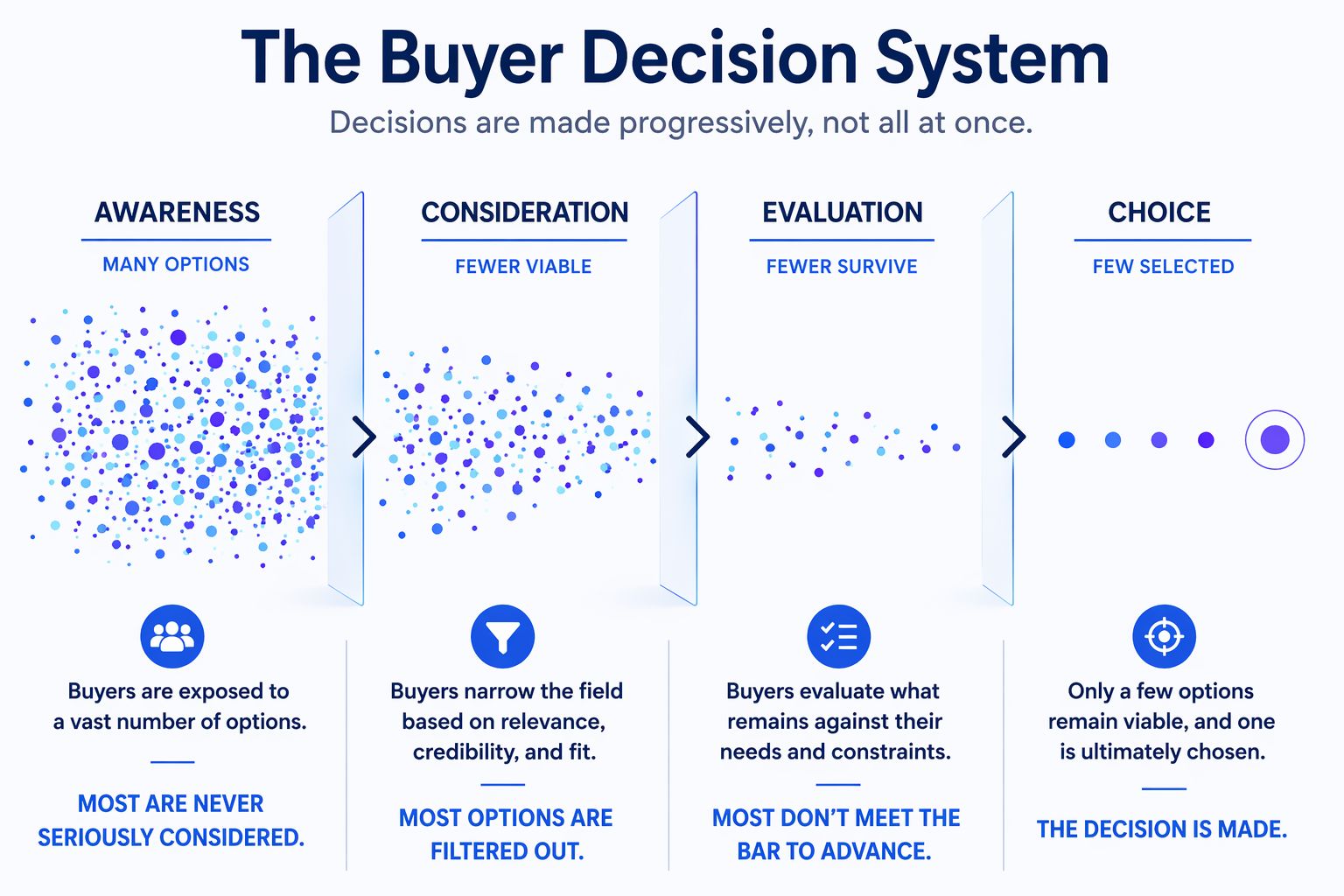
This framework is applied in global studies involving complex, high-stakes decisions across markets.
Where Most Research Breaks Down
Many research approaches assume:
- All options are equally known
- All options are equally considered
- Buyers evaluate all features objectively
- Price is evaluated independently of perceived quality
In reality, these assumptions do not hold.
Most decisions are shaped before trade-offs begin. When early-stage filtering is not captured, research can overstate demand, misrepresent competition, and lead to incorrect strategic decisions.
What Drives Real-World Outcomes
Outcomes are not determined by stated preference alone.
They are determined by which options enter and survive the decision process:
- Many options are never considered
- Some are eliminated before evaluation begins
- Trade-offs occur only within a constrained set of viable choices
This is why technically sound models can still misrepresent real-world behavior.
Why This Changes Strategy
When decisions are understood as a system, strategy changes:
- Pricing: Must reflect perceived credibility and risk—not just elasticity
- Positioning: Must align with where the brand is seen as credible
- Market Entry: Must account for whether the offering will be considered at all
- Segmentation: Must reflect how different buyers filter options
Decisions are not independent—they are shaped by the same underlying system.
How This Applies in Practice
This framework explains why many commonly used approaches can misrepresent outcomes:
- Why Conjoint Models Can Misrepresent Real Market Share
- Why Concepts Test Well—Then Fail in the Real Market
These are not isolated issues—they reflect the same underlying problem: research that begins after key decisions have already been made.
Final Thought
Most research describes behavior.
Few approaches model how decisions are actually formed.
When the full system is captured—awareness, consideration, risk, and trade-offs—insight shifts from description to prediction.
This framework connects directly to how we evaluate pricing, positioning, and market opportunity in practice.
This system is not theoretical.
It is built from decades of research experience into how decisions actually unfold in real markets.