
Why Conjoint Models Can Misrepresent Real Market Share
March 3, 2026
Why Concepts Test Well—Then Fail in the Real Market
April 22, 2026
Most global qualitative research fails
for a simple reason:
The respondent didn’t fully
understand the concept.
Not scale. Not sample.
Comprehension.
A typical Fortune 500 company generates a significant portion of its revenue from international markets, making global input essential for product, pricing, and strategy decisions. However, when interviewing B2B decision-makers worldwide, English frequently serves as a second or third language.
In a recent study, interviews were conducted with executives from Brazil, France, Germany, and Egypt, alongside respondents in English-speaking markets.
The challenge was not access—it was ensuring consistent understanding across markets.
When comprehension falters, the quality of insights diminishes.
This is how insight quality actually forms:
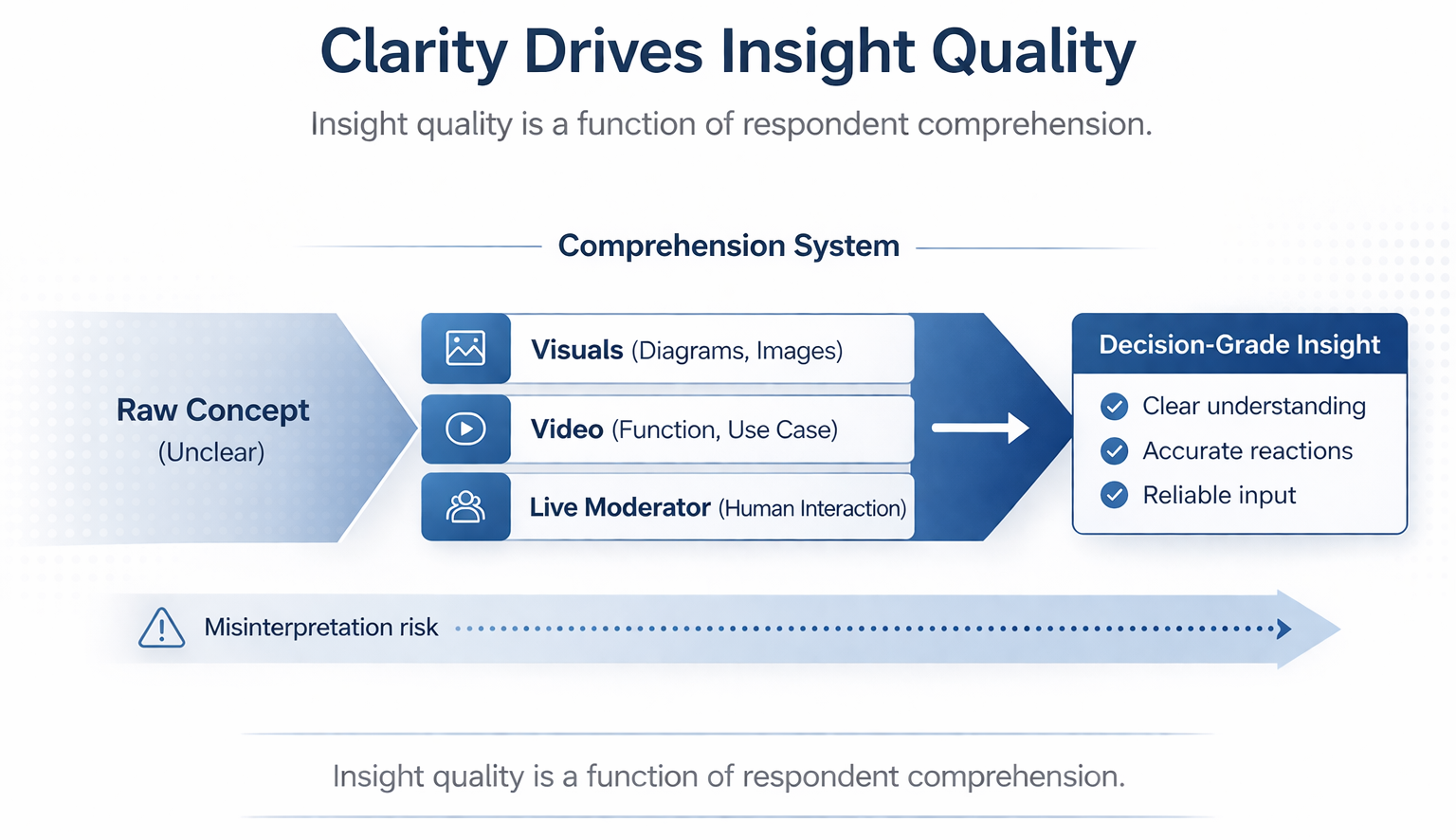
Stage 1: Raw Concept (Unclear)
Most research assumes:
- Respondents fully understand what is being asked
- Concepts are interpreted as intended
- Language does not materially affect responses
In global interviews, these assumptions often do not hold.
In the multi-country study, even highly capable executives:
- Interpreted product features differently
- Missed key elements of how the solution worked
- Focused on different aspects of the value proposition
One respondent put it directly:
“I understand part of it—but I’m not sure how it actually works in practice.”
— Facilities Director, Germany
At this stage, you are not measuring true reactions—
You are measuring reactions to a misunderstood concept.
Stage 2: The Comprehension System
The solution is not translation.
It is designing for comprehension.
Rather than using multiple local moderators—which often introduces inconsistency—we conducted all interviews in English and standardized how the concept was presented and understood.
Multi-Modal Communication (Core System)
- Visuals → diagrams clarified structure and relationships
- Video → demonstrated functionality and real-world use
- Live moderator (via Zoom) → adapted explanations and ensured alignment
This approach proved critical. Respondents could:
- See the moderator’s expressions and cues
- Follow visuals in real time
- Ask clarifying questions more naturally
The result: alignment in understanding across countries, not just translation of words.
Supporting Techniques (System Enhancers)
To further improve consistency:
- Pre-wire context (share a short primer & terminology before interview)
- Use precise, simple language (no idioms or ambiguity)
- Validate understanding (“How would you explain this to a colleague?”)
- Use structured probing (focus on risks, barriers, and real decisions
- Allow processing time (non-native speakers need time to process a 2nd language)
- Anchor in real-world decisions (“When did you last evaluate something similar?”)
Stage 3: Decision-Grade Insight
When comprehension is engineered correctly, the output changes.
In the multi-country study, once respondents clearly understood the concept:
- Feedback became more consistent across regions
- Differences reflected true market variation, not confusion
- Responses became more specific, critical, and actionable
The output becomes:
- Clear understanding
- Accurate reactions
- Reliable input for strategic decisions
Once the concept was clearly understood, feedback changed materially:
“Now that I see how it works, this is something we would seriously consider.”
— Operations Leader, Brazil
At this point, insight becomes decision-grade.
The Strategic Implication
Global qualitative research is not just about reaching respondents.
It is about ensuring that:
What you hear reflects what they actually think—
not what they were able to understand.
Firms that get this right produce:
- More reliable product feedback
- More accurate demand signals
- Better-informed strategic decisions
Firms that do not risk building strategy on misinterpreted insight.
Final Thought
In global research, language is not just a medium.
It is a source of risk.
The goal is not to conduct interviews worldwide.
It is to design interviews that work worldwide.