
Decisions Follow a System
By the time a choice is made, the outcome is often already shaped.
Most research begins at evaluation or choice.
We model what determines what becomes possible before that point.
Awareness → Consideration → Evaluation → Choice → Outcome
Most research focuses on the final choice.
We model the system that determines it.
Each stage shapes what becomes possible:
- Awareness — what enters the decision
- Consideration — what is taken seriously
- Evaluation — how alternatives are compared
- Decision — how trade-offs are made
So results mirror how markets actually function.
Most research describes behavior.
We model what determines outcomes.
We apply this system to decisions where outcomes must be understood before action is taken.
How We Model the System
Our approach does not treat these stages independently.
We model how they interact in real decision environments:
- How awareness constrains what is even possible
- How consideration filters reshape competitive dynamics
- How evaluation reflects risk, trade-offs, and real-world constraints
- How multiple stakeholders influence the final outcome
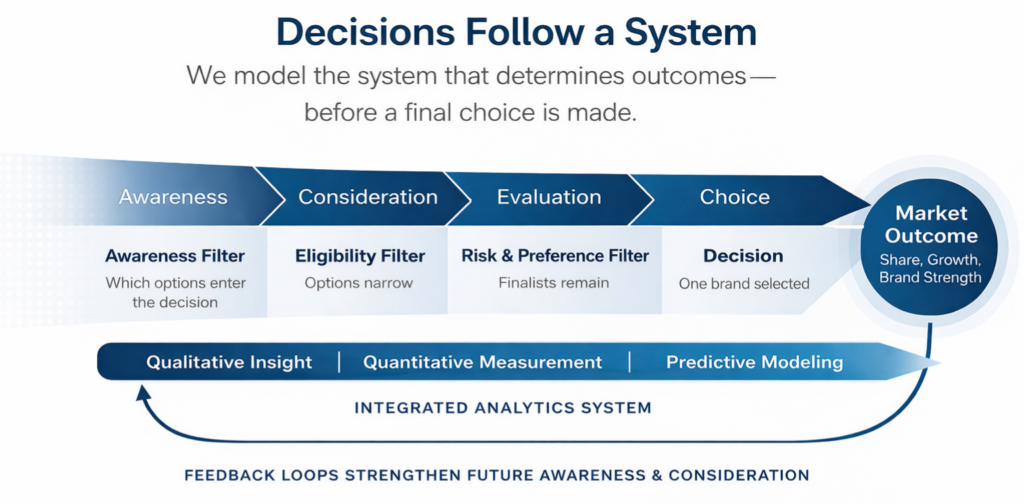
These stages interact to determine outcomes—long before a final choice is made.
Where Most Research Breaks Down
Most research assumes a market that does not exist.
Those assumptions drive the output.
When these assumptions fail, the conclusions fail with them.
Most research assumes:
- Equal awareness across options
- Full consideration of all alternatives
- Feature-driven decision-making
- Independence of price from perceived quality
- Single decision-maker assumption vs. multi-stakeholder decision processes
When these assumptions fail:
- Demand is overstated
- Share is misrepresented
- Pricing decisions are wrong
Where This Matters Most
We are typically engaged when decisions carry financial or strategic risk:
- New product viability
- Pricing strategy under uncertainty
- Competitive response
- Portfolio prioritization
Applying the Decision System
Awareness → Consideration → Evaluation → Choice → Outcome
We apply this system to decisions where outcomes must be understood before action is taken.
Decision Formation
Where decisions are defined—before evaluation begins
- Defines how the problem is framed
- Determines what criteria are used
- Shapes how risk is perceived
- Filters what enters consideration
Defines what is considered—and what never enters the decision.
Market Structure
Where competition is determined
- Defines the structure of the market
- Determines which trade-offs drive decisions
- Establishes price–value relationships
- Shapes choice within the consideration set
Determines which options advance—and which are eliminated before choice occurs.
The final stage of the decision system—where outcomes are determined
Modeling Market Outcomes
Where the decision system becomes predictive
- Simulates how decisions translate into market outcomes
- Reflects what is realistically considered
- Captures how competitors enter and exit
- Tests strategic scenarios under real conditions
Reveals what will actually happen—not just what respondents say they will do.
Our Role
We are not a fieldwork provider.
We are brought in when the decision must be right.